
To'lqinlarda chiziqli bo'lmagan rezonans reaksiyasi
Annotatsiya
Bunday kompozitsion strukturaning chiziqli bo'lmagan javobini ikki xil hissa bilan tavsiflash mumkin. Birinchisi, to'ldiruvchi dielektrikning samarali dielektrik o'tkazuvchanligining intensivlikka bog'liq qismidir. Oddiylik uchun, biz metall struktura umumiy shaklda elektr maydonining intensivligiga bog'liq bo'lgan o'tkazuvchanlikka ega bo'lgan chiziqli bo'lmagan dielektrik ichiga kiritilgan deb taxmin qilishimiz mumkin.
Kalit so'z
rezonansli, dielektrik, magnit
Nonlinear in waves resonant response
S.M. Usanova, A.A. Muxtorovb
a Kimyo International University in Tashkent, 156 Usman Nasyr Str., 100121, Tashkent, Uzbekistan
bTIQXMMIMTU "International House-Tashkent" Akademik Litseyi, 39 Kori Niyazov Str., Tashkent, Uzbekistan
Annatatsiya: Nonlinear response of such a composite structure can be characterized by two different contributions. The first one is an intensity-dependent part of the effective dielectric permittivity of the infilling dielectric. For simplicity, we may assume that the metallic structure is embedded into a nonlinear dielectric with a permittivity that depends on the intensity of the electric field in a general form
Keywords: resonant, dielectric, magnetic
First, we follow the original paper [1] and consider a two-dimensional composite structure consisting of a square lattice of the periodic arrays of conducting wires and split-ring resonators (SRR). We assume that the unit-cell size d of the structure is much smaller then the wavelength of the propagating electromagnetic field and, for simplicity, we choose the single-ring geometry of a lattice of cylindrical SRRs. The results obtained for this case are qualitatively similar to those obtained in the
more involved cases of double SRRs. This type of microstructured materials has recently been suggested and built in order to create left-handed metamaterials with negative refraction in the microwave region [2].
The negative real part of the effective dielectric permittivity of such a composite structure appears due to the metallic wires whereas a negative sign of the magnetic permeability becomes possible due to the SRR lattice. As a result, these materials demonstrate the properties of negative refraction in the finite frequency band, ω0 < ω < min(ωp, ω||m), where ω0 is the eigenfrequency of the SRRs, ω||m is the frequency of the longitudinal magnetic plasmon, ωp is an effective plasma frequency, and ω is the angular frequency of the propagating electromagnetic wave, (E , H) ∼ (E, H) exp (iωt). The split-ring resonator can be described as an effective LC oscillator (see, e.g. Ref. [7]) with the capacitance of the SRR gap, as well as an effective inductance and resistance.
Nonlinear response of such a composite structure can be characterized by two different contributions. The first one is an intensity-dependent part of the effective dielectric permittivity of the infilling dielectric. For simplicity, we may assume that the metallic structure is embedded into a nonlinear dielectric with a permittivity that depends on the intensity of the electric field in a general form,  D =
 D (|E|2 ). For results of calculations presented below, we take the linear dependence that corresponds to the Kerr-type nonlinear response.
The second contribution into the nonlinear properties of the composite material comes from the lattice of resonators, since the SRR capacitance (and, therefore, the SRR eigenfrequency) depends on the strength of the local electric field in a narrow slot. The intensity of the local electric field in the SRR gap depends on the electromotive force in the resonator loop, which is induced by the magnetic field. Therefore, the effective magnetic permeability µeff depends on the macroscopic (average) magnetic field H, and this dependence can be found in the form [8]
 (1)
where
 (2)
is the eigenfrequency of oscillations in the presence of the external field of a finite amplitude, h is the width of the ring,  , for h < δ, and
 , for h > δ. It is important to note that Eq. (1) has a simple physical interpretation: The resonant frequency of the artificial magnetic structure depends on the amplitude of the external magnetic field and, in turn, this leads to the intensity-dependent function µeff .
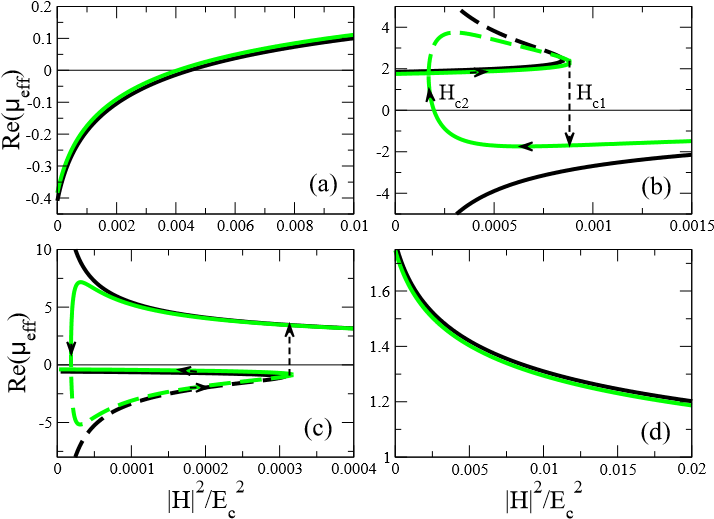
FIG. 1: Real part of the effective magnetic permeability vs. intensity of the magnetic field: (a) Ω > 1, α = 1;
(b) Ω < 1, α = 1, (c) Ω > 1, α = −1; and (d) Ω < 1, α = −1. Black
– the lossless case (γ = 0), grey–the lossy case (γ = 0.05). Dashed curves show unstable branches.
Figures 1 and 2 summarize different types of nonlinear magnetic properties of the composite, which are defined by the dimensionless frequency of the external field Ω = ω/ω0, for both a focusing [Figs. 1, 2(a,b)] and a defocusing [Figs. 1, 2(c,d)] nonlinearity of the dielectric.
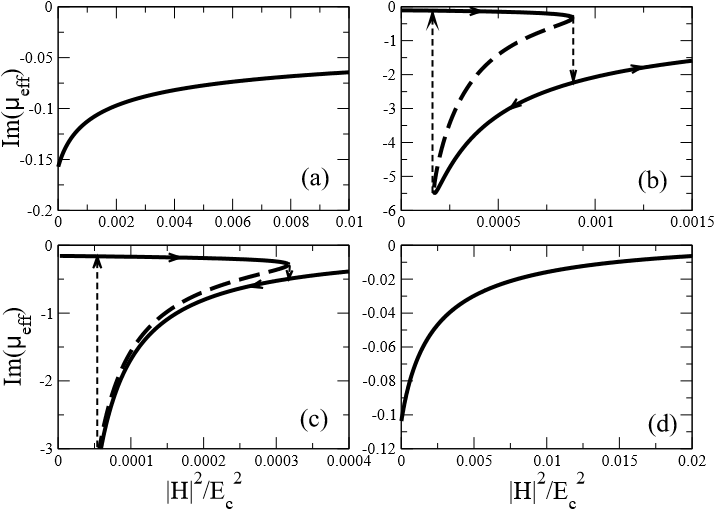
FIG. 2: Imaginary part of the effective magnetic permeability vs. intensity of the magnetic field for γ = 0.05: (a) Ω > 1, α = 1; (b) Ω < 1, α = 1, (c) Ω > 1, α = −1; and (d) Ω < 1, α = −1. Dashed curves show unstable branches.
Due to the high values of the electric field in the slot of SRR as well as resonant interaction of the electromagnetic field with the SRR lattice, the characteristic magnetic nonlinearity in such structures is much stronger then the corresponding electric nonlinearity. Therefore, magnetic nonlinearity should dominate in the composite metamaterials. More importantly, the nonlinear medium can be created by inserting nonlinear elements into the slots of SRRs, allowing an easy tuning by an external field.
The critical fields for switching between LH and RH states, shown in the Figs. 1 can be reduced to a desirable value by choosing the frequency close to the resonant frequency of SRRs. Even for a relatively large difference between the SRR eigenfrequency and the external frequency, as we have in Fig. 1(b) where Ω = 0.8 (i.e. ω = 0.8ω0), the switching amplitude of the magnetic field is ∼ 0.03Ec. The characteristic values of the focusing nonlinearity can be estimated for some materials such as n-InSb for which Ec = 200V/cm [3]. As a result, the strength of the critical magnetic field is found as Hc1 ≈ 1.6A/m. Strong defocusing properties for microwave frequencies are found in BaxSr1−xTiO3 (see Ref. [14] and references therein). The critical nonlinear field of a thin film of this material is Ec = 4 · 104V/cm, and the corresponding field of the transition from the LH to RH state [see Fig. 1 (c)] can be found as Hc ≈ 55.4A/m.
The unique possibility of strongly enhanced effective nonlinearities in the left-handed metamaterials revealed here may lead to an essential revision of the concepts based on the linear theory, since the electromagnetic waves propagating in such materials always have a finite amplitude. At the same time, the engineering of nonlinear composite materials may open a number of their novel applications such as frequency multipliers, beam spatial spectrum transformers, switchers, limiters, etc.
References
- A.A. Zharov, I.V. Shadrivov, and Yu.S. Kivshar, Phys. Rev. Lett. 91, 037401 (2003).
- D.R. Smith, W. Padilla, D.C. Vier, S.C. Nemat-Nasser, and S. Shultz, Phys. Rev. Lett. 84, 4184 (2000).
- A. M. Belyantsev, V. A. Kozlov and V. I. Piskaryov, Infrared Physics 21, 79 (1981).
- J.B. Pendry, A.J. Holden, W.J. Stewart, and I. Youngs, Phys. Rev. Lett. 76, 4773 (1996).
- J.B. Pendry, A.J. Holden, D.J. Robbins, W.J. Stewart, IEEE Trans. Microwave Theory Tech. 47, 2075 (1999).
- P. Markos and C.M. Soukoulis, Phys. Rev. E 65, 036622(2002); Phys. Rev. B 65, 033401 (2002).
- M. Gorkunov, M. Lapine, E. Shamonina, and K.H. Ringhofer, Eur. Phys. J. B 28, 263 (2002).
Fikrlar