
Nochiziqli uzatishning FDTD simulyatsiyalari
Annotatsiya
We analyze nonlinear properties of microstructured materials with the negative refractive index, the so-called left-handed metamaterials. We demonstrate that the hysteresis-type dependence of the magnetic permeability on the field intensity allows changing the material properties from leftto right-handed and back. Using the finite-difference time-domain simulations, we study the wave reflection from a slab of nonlinear left-handed material, and observe the propagation of temporal solitons in such materials
Kalit so'z
metamaterials
FDTD simulations of nonlinear transmission
S.M. Usanova, M.E. Akramovb, H.T. Yusupova
a Yeoju Technical Institute in Tashkent, 156 Usman Nasyr Str., 100121, Tashkent, Uzbekistan
bPhysics Department, National University of Uzbekistan, Vuzgorodok, Tashkent 100174,Uzbekistan
Annatatsiya: We analyze nonlinear properties of microstructured materials with the negative refractive index, the so-called left-handed metamaterials. We demonstrate that the hysteresis-type dependence of the magnetic permeability on the field intensity allows changing the material properties from leftto right-handed and back. Using the finite-difference time-domain simulations, we study the wave reflection from a slab of nonlinear left-handed material, and observe the propagation of temporal solitons in such materials.
In order to verify the specific features of the lefthanded metamaterials introduced by their nonlinear response, in this section we study the scattering of electromagnetic waves from the nonlinear metamaterial discussed above. In particular, we perform the FDTD numerical simulations of the plane wave interaction with a slab of LHM of a finite thickness. We use the Maxwell’s equations in the form
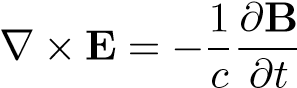 , (1)
 M, (2)
where hji is the current density averaged over the period of the unit cell, and M is the magnetization of the metamaterial. We base our analysis on the microscopic model recently discussed in Ref. [5], and write the constitutive relations in the form
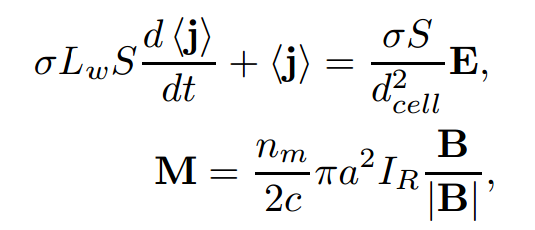 (3)
where Lw is the inductance of the wire per unit length, σ is the conductivity of metal in the composite, S is the effective cross-section of a wire, S ≈ πrw2 , for δ > rw, and S ≈ πδ(2r- δ) , where  is the skin-layer thickness, R is the current in SRR, nm is concentration of SRRs. The current in SRRs is governed by the equation
 , (4)
where L is inductance of the SRR, R is resistance of the SRR wire, U is the voltage on the SRR slit, and H′ is the acting (microscopic) magnetic field, which differs from the average (macroscopic) magnetic field. Voltage U at the slit of SRR is coupled to the current I through the relation
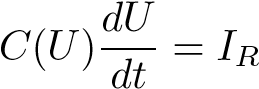 , (5)
with
 ,
where ǫ is the linear part of the permittivity of a dielectric material inside the SRR slit, Uc is the characteristic nonlinear voltage, and α = ±1 corresponds to the case of the focusing and defocusing nonlinear response, respectively.
FIG. 1: Reflection (solid) and transmission (dashed) coefficients for a slab of nonlinear metamaterial vs. the incident field intensity in a stationary regime, for the case of defocusing nonlinearity (α = −1). Inset shows real (solid) and imaginary (dashed) parts of the magnetic permeability inside the slab.
The microscopic magnetic field H′ can be expressed in terms of M and B using the Lorenz-Lorentz relation [16]:
H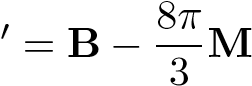 . (6)
As a result, Eqs. (2) to (6) form a closed system of coupled equations, and they can be solved numerically using, for example, the numerical FDTD method. We also notice that, by substituting the harmonic fields into these equations, we recover the expression for the magnetic permeability (1).
Our goal is to study the temporal dynamics of the wave scattering by a finite slab of nonlinear metamaterial. For simplicity, we consider a one-dimensional problem that describes the interaction of the plane wave incident at the normal angle from air on a slab of metamaterial of a finite thickness. We consider two types of nonlinear effects: (i) nonlinearity-induced suppression of the wave transmission when initially transparent left-handed material becomes opaque with the growth of the input amplitude, and (ii) nonlinearity-induced transparency when an opaque metamaterial becomes left-handed (and therefore transparent) with the growth of the input amplitude. The first case corresponds to the dependence of the effective magnetic permeability on the external field shown in Figs. 1(a,c), when initially negative magnetic permeability (we consider ǫ < 0 in all frequency range) becomes positive with the growth of the magnetic field intensity. The second case corresponds to the dependence of the magnetic permeability on the external field shown in Figs. 1(b).
In all numerical simulations, we use linearly growing amplitude of the incident field within the first 50 periods, that becomes constant afterwards. The slab thickness is selected as 1.3λ0 where λ0 is a free-space wavelength. For the parameters we have chosen, the metamaterial is lefthanded in the linear regime for the frequency range from f1 = 5.787 GHz to f2 = 6.05 GHz.
Our simulations show that for the incident wave with
FIG. 2: Reflection (solid) and transmission (dashed) coefficients for a slab of nonlinear metamaterial vs. the incident field intensity in a stationary regime, for the focusing nonlinearity (α = 1). Inset shows real (solid) and imaginary (dashed) parts of the magnetic permeability inside the slab.
the frequency f0 = 5.9 GHz (i.e. inside the lefthanded transmission band), electromagnetic field reaches a steady state independently of the sign of the nonlinearity. Both reflection and transmission coefficients in the stationary regime are shown in Figs. 1,2 as functions of the incident field amplitude, for both defocusing and focussing nonlinear response of the dielectric infilling the SRR slits. In the linear regime, the effective parameters of the metamaterial at the frequency f0 are: ǫ = −1.33 − 0.01i and µ = −1.27 − 0.3i; this allows excellent impedance matching with surrounding air. The scattering results in a vanishing reflection coefficient for small incident intensities (see Figs.).
References
- J.B. Pendry, A.J. Holden, W.J. Stewart, and I. Youngs, Phys. Rev. Lett. 76, 4773 (1996).
- J.B. Pendry, A.J. Holden, D.J. Robbins, W.J. Stewart, IEEE Trans. Microwave Theory Tech. 47, 2075 (1999).
- P. Markos and C.M. Soukoulis, Phys. Rev. E 65, 036622(2002); Phys. Rev. B 65, 033401 (2002).
- D.R. Smith, W. Padilla, D.C. Vier, S.C. Nemat-Nasser, and S. Shultz, Phys. Rev. Lett. 84, 4184 (2000).
- I.V. Shadrivov, N.A. Zharova, A.A. Zharov, and Yu.S. Kivshar, Phys. Rev. E 70 (2004) (in press).
Fikrlar