
Субволновые дискретные солитоны в нелинейных метаматериалах
Аннотация
Здесь мы представляем первое исследование субволновых дискретных солитонов в нелинейных MDML на видимых и ближних инфракрасных частотах. Эти солитоны проявляют уникальные особенности, возникающие из-за тройного взаимодействия между периодичностью, нелинейностью и туннелированием SPP, и демонстрируют аномальное поведение по сравнению с солитонами в однородных диэлектрических средах и обычными DWGA
Ключевые слова
постоянные распространения, электрическое поле, диэлектрик
Subwavelength Discrets Solitons in Nonlinear Metamaterials
Sulton Usanova, Sheroz Usanovb, Gulsanam Usanovac
a Yeoju Technical Institute in Tashkent, 156 Usman Nasyr Str., 100121, Tashkent, Uzbekistan
b Tashkent Institute of Irrigation and Agricultural Mechanization Enginees, National Research University, 39 Kori Niyazov Str., Tashkent, Uzbekistan
c School 61, Ishtikhon district, Samarkand region. Zarband
Annatatsiya: Here, we present the first study of subwavelength discrete solitons in nonlinear MDMLs, at visible and nearinfrared frequencies. These solitons manifest unique features arising from the threefold interplay between periodicity, nonlinearity, and SPPs tunneling, and display anomalous behaviors comparing to solitons in uniform dielectric media and conventional DWGAs.
Keywords: propagation constants, electric field, dielectric
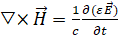
We derive the governing eigenproblem directly from Maxwell’s equations
 (1)
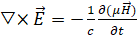 (2)
where c is the speed of light in vacuum,  and
 are the electric and magnetic fields, respectively,
 is the spatially varying dielectric permittivity, and the magnetic permeability
 is set to be 1. We solve Eq. (2) for timeharmonic propagation along the z axis, taking into account the transverse magnetic (TM) nature of the SPPs waves [5] [i.e.,
 and
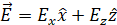 , see the coordinates in Fig. 1. By properly rearranging Eq. (1), and introducing a ‘‘Hamiltonian’’ operator
 , it is straightforward to obtain an explicit matrix form
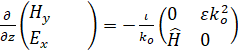 (3)
where  (
 is the wavelength in vacuum). The EM eigenmodes of such a system maintain their envelopes during propagation, that is,

 (4)
where  indicates the propagation constant. Substituting Eq. (4) we obtain the eigenvalue problem
 (5)
where 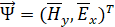
The eigenproblem in Eq. (5) is calculated numerically by considering the boundary conditions for the EM fields at the metal-dielectric interfaces. The solutions of Eq. (5) form a set (or a band) of eigenvalues representing the linear propagation constants supported by the system. In what follows, we choose the dielectric slab width  , and metal slab width
 . The dielectric linear refractive index is
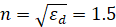 , and the metal relative permittivity at
 is taken to be
 (the effect of metal loss will be discussed later) .
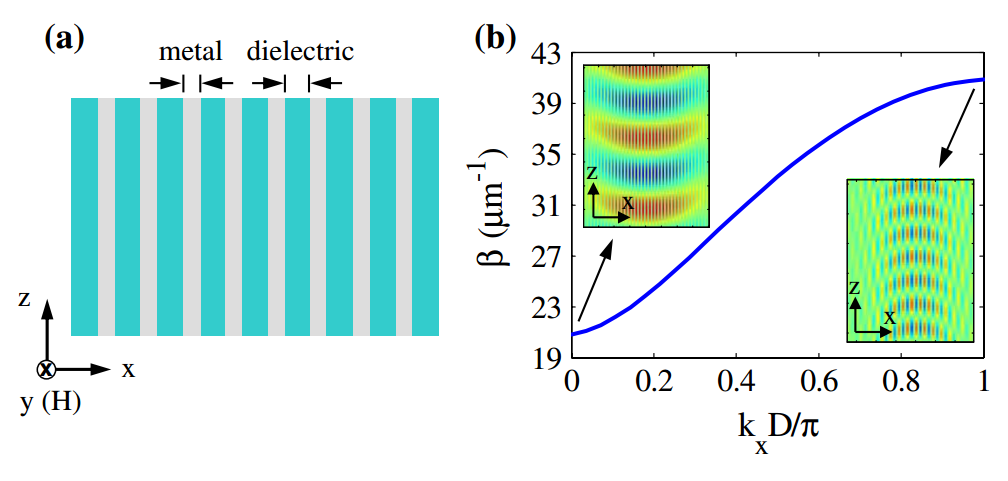
Figure 1: (color online). (a) Schematic of MDMLs. (b) Diffraction-relation diagram (propagation constant vs transverse momentum). The insets show the transverse electric field of a diffracting narrow beam originating from the  and
 points in the momentum space.
The variation of  with the transverse momentum kx shown in Fig. 1(b) presents a trend opposite to the one for conventional DWGAs. Namely,
 is smaller than
 . Interestingly, the modal profiles of tangential fields are identical to those of the second-band modes of a paraxial DWGA, and correspond to ‘‘negative’’ coupling between neighboring waveguides. As a result, the curvature of the band (i.e., the 2nd derivative) is positive at
 , and negative at
 , indicating that the diffraction of a localized wave packet is anomalous at
 and normal at
 , in a sharp contrast to what is observed in DWGAs. This phenomenon is presented by the insets in Fig. 1(b), where a narrow wave packet at

 is shown to acquire a concave (convex) phase front as it propagates through the media and diffracts.
References
- A.Sihvola (2007), Metamaterials in electromagnetics, Metamaterials1, 2-11.
- Aos Al-waidh (2009), metamaterials, General Engineering Research Institute, John Moores University
- B .Monk (2000),Metamaterials-Critique and Alternatives, A John willey sons, INC publications, Merits.
- DaviBibianoBrito (2010), Metamaterial inspired improved antenna and circuits, UFRN, pp.19-27.
Комментарии