
Материалы с отрицательным показателем преломления
Аннотация
Модели электрической и магнитной проницаемости показывают, как эти свойства могут проявляться по-разному. Поэтому может возникнуть интересный вопрос: «Сколько различных возможностей существует?». Возможный ответ состоит в том, что, говоря с теоретической точки зрения, возможна любая комбинация знаков. Следовательно, и диэлектрическая проницаемость, и проницаемость могут быть положительными, мы называем эти материалы двойными положительными (DPS), обе константы могут быть отрицательными, мы называем эти материалы двойными отрицательными (DNG), или только одна из двух констант может быть негативные, мы называем эти материалы эпсилон-негативными (ЭНГ) и мю-негативными (МНГ) соответственно.
Ключевые слова
электромагнитный, показатель преломления, отрицательный
The negative refractive index materials
S.M. Usanova, G.M. Usanovab
a Yeoju Technical Institute in Tashkent, 156 Usman Nasyr Str., 100121, Tashkent, Uzbekistan
b School 61, Ishtikhon district, Samarkand region. Zarband
Annatatsiya: The models of the electric permittivity and magnetic permeability show how these properties can present many different behaviors. Therefore, an interesting question can be: “How many different possibility do exist?”. A possible answer is that, talking from a theoretical point of view, any combination of sign is possible. Therefore, both the permittivity and the permeability can be positive, we call these materials Double-Positive (DPS), both the constants can be negative, we call these materials Double-Negative (DNG), or only one of the two constants can be negative, we call these materials Epsilon-Negative (ENG) and Mu-Negative (MNG), respectively.
Keywords: electromagnetic, refractive index, negative
In a  diagram is shown. This diagram was proposed by Veselago in his paper on DNG materials in 1968. In the first quadrant we find the DPS materials, i.e., the ordinary isotropic dielectrics. In these materials, as it is well known, the propagation of electromagnetic waves is allowed, in fact, the refractive index of these materials is purely real (It is well understood that we are neglecting the losses in this analysis.):
 (Here we are using the subscript “r” to indicate the relative permittivity and permeability.). In the second quadrant, we find the ENG materials, as metals or plasmas below the plasma frequency. In these media, the refractive index is purely imaginary,
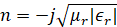 . Therefore, the propagation of waves is not allowed, and we can find only evanescent waves in these media. The same we can say about the fourth quadrant. About the third quadrant, we find a very strange behavior, in fact in this case the refractive index of the material is again real. Therefore, the electromagnetic propagation is allowed in these materials. From this analysis, it is natural to ask what is the behavior of an electromagnetic wave in this material. In order to understand this behavior, we can consider the Maxwell equations:
 (1)
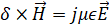 (2)
if we looking for a plane wave solution exp  , we can write the first equation as follows:
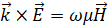 (3)
moreover, let us consider the Poynting vector in the frequency domain:
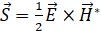 (4)
From equation (3), we see that, in a DPS material, the three vectors k, E, and H are right-handed. Similarly, from equation (4), we see that the three vectors S, E, and H are right-handed. On the other hands, if we suppose that the medium is DNG, from equation (3), we find that the three vectors k, E, and H are left-handed, while the three vectors S, E, and H remain right-handed. Therefore, in a DNG material the propagation vector and the Poynting vector are anti-parallel, i.e., they lie on the same line, but they point in opposite directions. As we will see, this fact bring many consequences. First of all, we want to give a mathematical formulation of this fact. Let us call  the unit vector parallel to the Poynting vector:
 (5)
where S is the magnitude of the Poynting vector. Than, we can always write the propagation vector as follows:
 (6)
where 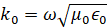 is the vacuum wave number, and n is the refractive index of the material. From this definition, we can see that in a DPS material the refractive index must be positive, while in a DNG material it must be negative. Therefore, we can define the refractive index as follows:
 (7)
In a way, it is as if the to cases of DPS and DNG materials correspond, in a mathematical point of view, to the two determinations of the square root.
Following to the previous discussion, we can understand the names used in the literature to refer to the DNG materials. One of them is “left-handed materials,” to indicate that in these materials the three vectors k, E, and H are left-handed. Another name widely used is “Negative Refractive Index (NRI) materials”, to indicate that in these materials the refractive index is negative. Another name used sometimes is “backward-wave materials”, to indicate that in these materials the phase change in the opposite direction with respect to the energy.
The definition of a negative refractive index it is useful in order to understand the nature of a DNG material, but it is useful also in order to obtain some interesting behavior of these media. Let us make some examples.
Let us consider as a first example the Doppler effect. As it is well known, when an electromagnetic source generates an electromagnetic radiation at frequency  , and it is in relative motion with respect to an observer, than the observer “sees” an electromagnetic wave at a frequency different from
 , in particular, he sees a frequency:
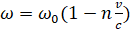 (8)
where v is the relative velocity between the source and the observer, while c is the speed of light in a vacuum. In a DPS medium, we see that, if the observer is going away from the source, than the velocity is positive, and the observed frequency is less than the source frequency, i.e., the wavelength is larger, while if the observer is going toward the source, than the velocity is negative and the observed frequency is greater than the source frequency, i.e., the wavelength is smaller. Now in a DNG material, we find exactly the opposite behavior, in fact, being the refractive index negative, when the observer goes away from the source the observed wavelength is smaller than the source wavelength, while when the observer goes toward the source, the observed frequency is larger than the source wavelength. This behavior is amazing and counterintuitive. We can understand it if we think that the Doppler effect is a consequence of the relative motion between the observer and the radiation phase. Therefore, we have not to think to the relative motion with respect to the source, but with respect to the phase. Since the phase velocity, in the DPS and in the DNG materials has opposite velocities, it is obvious that the Doppler effect returns opposite behaviors in the two cases. Another surprising fact, is that we obtained this result with out any calculation. We just considered the formula of the Doppler effect, and we considered what happen when the refractive index becomes negative.
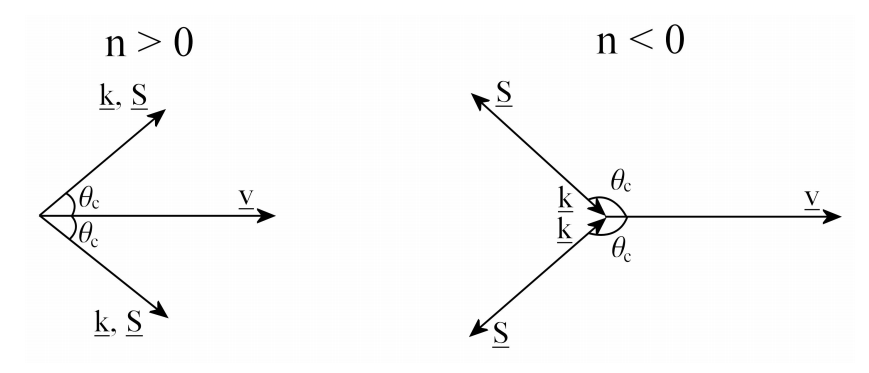
Figure 1: Cerenkov radiation in DPS and DNG materials.
For this reason it is very important to have found the model of negative refractive index to describe the DNG materials.
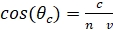
Another interesting example is related to the Cherenkov radiation. It is the electromagnetic radiation emitted by a charged particle that is moving in a material with a velocity v greater than the speed of light in the material, i.e.,  . The radiation is emitted with an angle θC with respect to the direction of propagation of the particle, see Figure (1). The expression of this angle is the following:
 (9)
References
- Adnan Noor (2010), Metamaterial Electromagnetic Absorbers and Plasmonic Structures, pp.42-43.
- A.Sihvola (2007), Metamaterials in electromagnetics, Metamaterials1, 2-11.
- Aos Al-waidh (2009), metamaterials, General Engineering Research Institute, John Moores University
- B .Monk (2000),Metamaterials-Critique and Alternatives, A John willey sons, INC publications, Merits.
Комментарии