
Реализация метаматериала
Аннотация
Мы показали много интересных эффектов и применений левых материалов. Теперь вопрос в том, возможно ли реализовать такие материалы! В литературе, особенно в последнее десятилетие, было предложено множество методов для получения DNG-материала с настраиваемыми свойствами.
Ключевые слова
смещение, электрическое поле, магнитный диполь
Realization of a metamaterial
Sulton Usanova, Sheroz Usanovb
a Yeoju Technical Institute in Tashkent, 156 Usman Nasyr Str., 100121, Tashkent, Uzbekistan
b Tashkent Institute of Irrigation and Agricultural Mechanization Enginees, National Research University, 39 Kori Niyazov Str., Tashkent, Uzbekistan
Annatatsiya: We shown many interesting effects and applications of the left-handed materials. The question now is if it is possible to realize such materials! In the literature, especially in the last decade, many techniques have been proposed in order to obtain a DNG material with configurable properties.
Keywords: displacement, electric field, magnetic dipole
The possibilities are several and the topic is hard to be covered in its whole entirety. Here, we aim to draw the ideas behind some of these techniques.
If we call  the conductivity of the wires, their resistance for unit length can be written as follows:
 (1)
About the effective inductance for unit length of the wires, it is a little bit more complicate to calculate, and we simply give the final result:
 (2)
At this point, we know that the relation between the voltage and the current, between unit length, in the unit cell is the following:
 (3)
where V and I are the voltage and the current between unit length, respectively. The voltage per unit length is related to the electric field parallel to the wires Ez, on the other hand, the displacement current is related to the electric field as follows:
 (4)
hence:
 (5)
where we defined the current in the unit cell as  , in the hypothesis that the unit cell is much smaller than the wavelength, i.e.,
 . Obtaining I from the last equation, and inserting in (3.3), we obtain:
 (6)
being:
 (7)
we obtain:
 (8)
with:
 (9)
 (10)
We recognize in (8) an effective permittivity as in the Drude model. In this expression, we can design, by varying the dimensions of the wires array, the plasma frequency, i.e., we can obtain negative permittivities at a very low frequency. The wire medium allow us to design an artificial medium with a configurable permittivity.
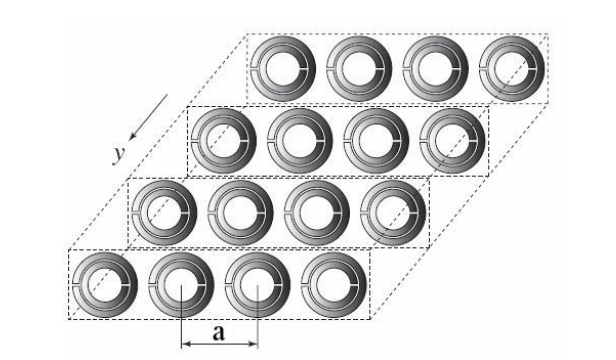
Figure 1: A sketch of a SRR medium, Split rings are aligned in y−direction and they are spaced of a distance a.
At this point, we must show how to obtain a medium with a configurable permeability. We consider the so called Split Ring Resonator (SRR) medium, see Fig. 1. A rigorous analysis of the SRR is not a simple task and it leaves aside the purposes of this report. Here, we give a very simple model of the SRR just to understand its principle of operation. The SRR is characterized by a resistance, due to the conductive losses, an inductance, due to the ring shape, and by a capacitance, due to the split on the ring, Therefore, the relation between the voltage and the current of the single ring is the following:
 (11)
The relation between the voltage and the magnetic field applied on the SRR, in the hypothesis of magnetic field orthogonal to the plane of the SRR, is the following:
 (12)
where S is the effective surface looking at the SRR as an elemental current loop. On the other hand, the magnetic dipole moment of the SRR between unit volume can be obtained as following:
 (13)
where  is the effective volume. As a consequence, we can obtain the relation between the magnetic dipole moment and the magnetic field:
 (14)
with:
 (15)
 (16)
 (17)
reminding the relation between the magnetic dipole moment and the magnetic field:
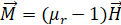 (18)
we obtain (A more accurate analysis returns the following expression:
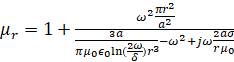 (19)
where a is the unit cell dimension, r is the internal radius of the SRR,  is the conductivity of the sheets,
 is the width of the sheets and
 is the distance between the two concentric rings.We can see that this expression has the same dependence on frequency of the one obtained in this report.):
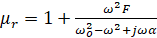 (20)
we found here an expression for the permeability very similar to the one of a magnetized ferrite. Again, with this medium we can obtain a configurable value of the permeability.
References
- Adnan Noor (2010), Metamaterial Electromagnetic Absorbers and Plasmonic Structures, pp.42-43.
- A.Sihvola (2007), Metamaterials in electromagnetics, Metamaterials1, 2-11.
- Aos Al-waidh (2009), metamaterials, General Engineering Research Institute, John Moores University
- B .Monk (2000),Metamaterials-Critique and Alternatives, A John willey sons, INC publications, Merits.
Комментарии