
NONLINEAR ELECTROMAGNETIC SPATIAL SOLITON
Аннотация
При таком многозначном нелинейном магнитном отклике области с разными значениями магнитной проницаемости, «возбуждаемые» пространственным солитоном, можно рассматривать как эффективные индуцированные левые волноводы, делающие возможным существование одногорбых и многогорбых волноводов. солитонные структуры. Благодаря наличию таких областей солитоны могут быть не только симметричными, но и антисимметричными и даже асимметричными.
Ключевые слова
солитон, симметричный, резонансный.
Автор
S.M. Usanov, I.X. Ibragimov, H.T. Yusupov, A.A. Muxtorov
NONLINEAR ELECTROMAGNETIC SPATIAL SOLITON
S.M. Usanova, I.X. Ibragimova, H.T. Yusupova, A.A. Muxtorovb
aKimyo International University in Tashkent, 156 Usman Nasyr Str., 100121, Tashkent, Uzbekistan
bTIQXMMIMTU "International House-Tashkent" Academic Lyceum, 39 Kori Niyazov Str., Tashkent, Uzbekistan
Similar to other nonlinear media [1], nonlinear lefthanded composite materials can support self-trapped electromagnetic waves in the form of spatial solitons. Such solitons possess interesting properties because they exist in materials with a hysteresis-type (multi-stable) nonlinear magnetic response. Below, we describe novel and unique types of single and multi-hump (symmetric, antisymmetric, or even asymmetric) backward-wave spatial electromagnetic solitons supported by the nonlinear magnetic permeability.
Spatially localized TM-polarized waves that are described by one component of the magnetic field and two components of the electric field. Monochromatic stationary waves with the magnetic field component H = Hy propagating along the z-axis and homogeneous in the y-direction, [∼ exp(iωt − ikz)], are described by the dimensionless nonlinear Helmholtz equation,
where γ = kc/ω is a wavenumber, x = x′ω/c is the dimensionless coordinate, and x′ is the dimensional coordinate. Different types of localized solutions of Eq. (1) can be analyzed on the phase plane (H,dH/dx) (see, e.g., Refs. [2]). First, we find the equilibrium points: the point (0,0) existing for all parameters, and the point (0,H1), where H1 is found as a solution of the equation.
Below the threshold, i.e. for γ < γtr, where γtr= [1 + FΩ2/(1 − Ω2)], the only equilibrium state (0,0) is a saddle point and, therefore, no finite-amplitude or localized waves can exist. Above the threshold value, i.e. for γ > γtr, the phase plane has three equilibrium points, and a separatrix curve corresponds to a soliton solution.
In the vicinity of the equilibrium state (0,0), linear solutions of Eq. (1) describe either exponentially growing or exponentially decaying modes. The equilibrium state (0,H1) describes a finite-amplitude wave mode of the transverse electromagnetic field. In the region of multi-stability, the type of the phase trajectories is defined by the corresponding branch of the multi-valued magnetic permeability. Correspondingly, different types of the spatial solitons appear when the phase trajectories correspond to the different branches of the nonlinear magnetic permeability.
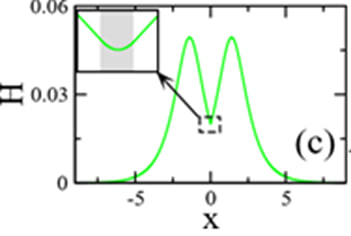
FIG. 1: Solitons with one domain of negative or positive magnetic permeability (shaded), respectively. Insets in show the magnified regions of the steep change of the magnetic field.
The fundamental soliton is described by the separatrix trajectory on the plane (H,dH/dx) that starts at the point (0,0), goes around the center point (0,H1), and then returns back; the corresponding soliton profile is shown in Fig. 1(a). More complex solitons are formed when the magnetic permeability becomes multi-valued and is described by several branches. Then, soliton solutions are obtained by switching between the separatrix trajectories corresponding to different (upper and lower) branches of magnetic permeability. Continuity of the tangential components of the electric and magnetic fields at the boundaries of the domains with different values of magnetic permeability implies that both H and dH/dx should be continuous. As a result, the transitions between different phase trajectories should be continuous.
Figures 1(b,c) show several examples of the more complex solitons corresponding to a single jump to the lower branch of µ(H) (dotted) and to the upper branch of µ(H) (dashed), respectively. The insets show the magnified domains of a steep change of the magnetic field. Both the magnetic field and its derivative, proportional to the tangential component of the electric field, are continuous. The shaded areas show the effective domains where the value of magnetic permeability changes. Figure 1(d) shows an example of more complicated multi-hump soliton which includes two domains of the effective magnetic permeability, one described by the lower branch, and the other one – by the upper branch. In a similar way, we can find more complicated solitons with different number of domains of the effective magnetic permeability.
We note that some of the phase trajectories have discontinuity of the derivative at H = 0 caused by infinite values of the magnetic permeability at the corresponding branch of µeff(H). Such a non-physical effect is an artifact of the lossless model of a left-handed nonlinear composite considered here for the analysis of the soliton solutions. In more realistic models that include losses, the region of multi-stability does not extend to the point H = 0, and in this limit the magnetic permeability remains a single-valued function of the magnetic field [3].
For such a multi-valued nonlinear magnetic response, the domains with different values of the magnetic permeability ”excited” by the spatial soliton can be viewed as effective induced left-handed waveguides which make possible the existence of single- and multi-hump soliton structures. Due to the existence of such domains, the solitons can be not only symmetric, but also antisymmetric and even asymmetric. Formally, the size of an effective domain can be much smaller than the wavelength and, therefore, there exists an applicability limit for the obtained results to describe nonlinear waves in realistic composite structures.
When the infilling dielectric of the structure displays self-focusing nonlinear response, we have Ω < 1, and in such system we can find dark solitons, i.e. localized dips on the finite-amplitude background wave [1]. Similar to bright solitons, there exist both fundamental dark solitons and dark solitons with domains of different values of magnetic permeability. For self-defocusing nonlinearity and Ω < 1, magnetic permeability is a single-valued function, and such a nonlinear response can support dark solitons as well, whereas for self-focusing dielectric, we have Ω > 1 and no dark solitons can exist.
References
- 1. For a comprehensive overview of spatial solitons in nonlinear optics, see Yu.S. Kivshar and G.P. Agrawal, Optical Solitons: From Fibers to Photonic Crystals (Academic Press, San Diego, 2003), 540 pp.
- 2. V. B. Gil’denburg, A. V. Kochetov, A. G. Litvak, and A. M. Feigin, Sov. Phys. JETP 57, 28 (1983)(in Russian)[Zh. Eksp. Teor. Fiz. 84, 48 (1983)].
- 3. A.A. Zharov, I.V. Shadrivov, and Yu.S. Kivshar, Phys. Rev. Lett. 91, 037401
Комментарии