
FEATURES OF THE GROWTH OF CARP (CYPRINUS CARPIO) OF THE TUDAKUL RESERVOIR IN THE CONDITIONS OF PASTURE AQUACULTURE
Аннотация
Изучена размерно-возрастная характеристика сазана (Cyprinus carpio Linnaeus) Тудакульского водохранилища. Показано что линейный рост длины тела и массы одновозрастных групп сазана Тудакульского водохранилища колеблется в широких пределах. Такая разноразмерность одновозрастных групп рыб могло стать ошибочным определения истинного темпа роста сазана Тудакульского водохранилища. Сопоставление полученных данных с литературными дало возможность выявить, что линейный рост сазана Тудакульского водохранилища значительно выше по сравнению с другими водоемами Узбекистана.
Ключевые слова
x
Автор
А.А.Amrullaev, J.J.Sobirov, Т.V.Salixov
FEATURES OF THE GROWTH OF CARP (CYPRINUS CARPIO) OF THE TUDAKUL RESERVOIR IN THE CONDITIONS OF PASTURE AQUACULTURE
А.А.Amrullaev2, J.J.Sobirov1, Т.V.Salixov1
1 – Institute of zoology, Uzbekistan Academy of Sciences, Uzbekistan
2 – Tashkent State Agrarian University, Uzbekistan
Introduction. The Tudakul reservoir is a self-leveling reservoir created based on Lake Tudakul in the 1950s of the last century. The area of the Tudakul reservoir is 22 thousand hectares, the volume is about 2 billion m3, the maximum depth is 17 m, and the average is 5-7 m. The reservoir is filled in winter and partly in spring.
By the Resolution of the Cabinet of Ministers of the Republic of Uzbekistan dated August 7, 2017 no 593 "On measures to establish a fund for the development of fisheries and the leasing of natural reservoir areas to hunting fishing farms", fishing at the Tudakul reservoir is carried out on a quota-free basis. Golden Lake Fish LLC has been operating the Tudakul reservoir on a rental basis since 2018. LLC "Golden Lake Fish" is a full-system farm, where the breeding and cultivation of fish is carried out from eggs to marketable products, and the reservoir itself is used as a feeding pond. To increase fish production, the Golden Lake Fish reservoir, LLC, has been regularly introducing carp yearlings and herbivorous fish – white carp, mottled carp, and white cupid – since 2018.
The modern distribution of carp is determined not so much by its natural distribution across river basins, as by the increased stocking of reservoirs by carp. Carp is one of the main objects of breeding in fish farms of the CIS countries. It is widely used in fish farming in Eastern Europe and Asia (China, Japan, and Vietnam, etc.) [4]. The predecessor of the cultural carp is the wild carp. In the process of domestication, its morphological features have changed. The carp's body has become high back. Carp appeared with various forms of scaly cover: with scattered or linear scaly cover, as well as completely devoid of scales. Modern carp breeds are characterized by highly productive qualities: rapid growth, effective use of feed, and high fertility in ponds and garden farms.
On the other hand, carp have a higher survival rate in natural reservoirs and greater resistance to infectious and parasitic diseases. Carp was brought to Uzbekistan in the twentieth century from several European countries – Russia, Ukraine, Hungary, etc., and because of this is an alien form for the fauna of Uzbekistan, the artificial settlement of which in the reservoirs of Uzbekistan goes against the international Convention on Biodiversity signed by the Republic of Uzbekistan.
Carp occupies one of the first places in the fishery and makeup on average about 50% of the total catch for the rational use of the carp population (Cyprinus carpio Linnaeus) The Tudakul reservoir, especially with quota-free fishing, is necessary to know the commercial reserves of this species. However, as the analysis of literary data shows, observations of the formation of the ichthyofauna of the Tudakul reservoir are not properly systematized, often information obtained several decades ago is automatically transferred from one literary source to another without proper verification. Therefore, now there is no accurate information about the stock of commercial fish species. To achieve the desired result, constant monitoring (monitoring) of the state of the hydroecosystem and its biological resources is necessary.
Materials and methods. The material for this study was the collections of 2020-2022, including all periods of the year from the Tudakul reservoir. 375 specimens of carp (Cyprinus carpio Linnaeus) were collected and examined. The collected material was processed according to generally accepted ichthyological methods [2, 3].
To study and establish the size and age composition of commercial fish, the material was selected from the catches of non-aquatic fishing crews, and also used active fishing gear, as which a set of nets with mesh from 22 to 140 mm was used. The set nets were displayed in the form of an order, one net of all sizes, on various sections of the reservoir.
Results and discussions. Carp (Cyprinus carpio Linnaeus) is unpretentious to the conditions of keeping and easily adapts to changes in the hydrochemical regime, food supply, and other environmental factors.
Currently, the wild form of carp and carp (cultural form) as well as their crossbreed are found in the Tudakul reservoir, most of which are high-bodied forms.
The carp population of the Tudakul reservoir is formed due to natural reproduction and stocking by carp. In recent years, there has been a decrease in carp catches.
The carp population is represented by individuals aged 0 + 9+ years. The population is based on 3-6-year-old individuals. In general, carp aged 2+ ranges from 40-70%, and the proportion of older age groups (3+, 6+) is relatively low, but in recent years there has been an increase.
The rate of its linear and weight growth is relatively high and varies quite widely. As shown in Fig.1, two–year–olds had an average weight of 652.9 g, and a length of 27.2 cm, three-year-olds had an average weight of 1434.8 g, a length of 37.0 cm, four-year-olds respectively - 2521.7 g and 46.0 cm, five-year-olds - 4557.5 g and a length of 56.7 cm, six-year-olds 7218.5 g and a length of 69.8 cm, seven-year-olds 9218.4 g and a length of 71.2 eight-year-olds 9800 g and 73.3 cm long, nine-year-olds 12666.7 g and 78.7 cm long, ten-year-olds 15060 g and 80 cm long. Annual increases in body length range from 14.19 cm (1+) to 1.33 cm (9+).
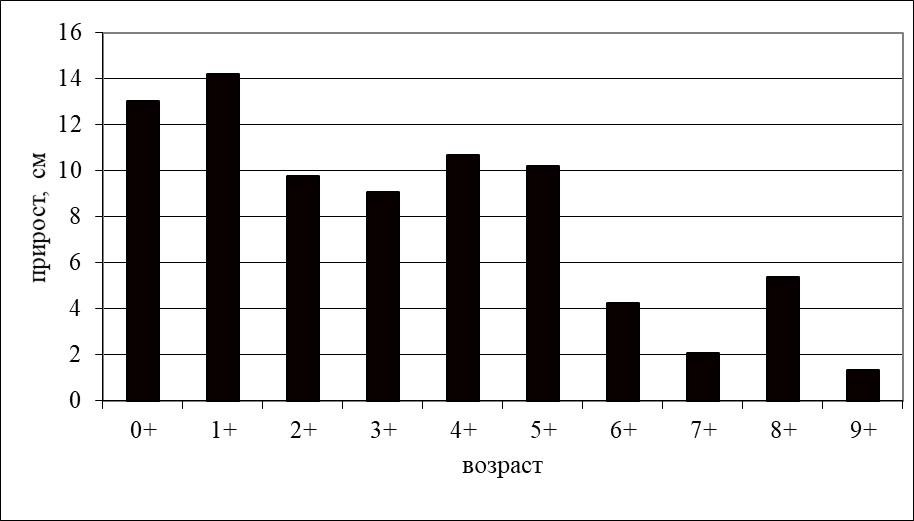
FIG. 2. Increase in body length of carp (Cyprinus carpio Linnaeus) Tudakul reservoir by age groups (according to empirical data from 2020-2022).
Compared with other reservoirs, there is a big difference in growth characteristics, for example, in the literature, there are data with a lower growth rate compared to our data, in the Kuyumazarsky reservoir, Shurkul reservoir, as well as in the lakes Dengizkul and Karakyr [1]. In the Yuzhnosurkhan reservoir, a carp aged 2 + has an average length of 19.7 cm, a mass of 187.5 g, 3+ - 24.3 cm and 345.0 g; 4+ - 29.3 cm and 560.2 g; 5+ - 32.3 cm and 715.5 g; 6+ - 41.0 cm and 1321.0 g; 7+ - 46.6 cm and 1834.0 g; 8+ - 50.9 cm and 2257.0 g; 9+ - 53.6 cm and 3790.0 g [5].
As can be seen from Fig. 3, the linear growth of the body length of the carp in the Tudakul reservoir is very different from other reservoirs, such a phenomenon can be explained by the erroneous determination of age by other researchers, in which the studies conducted were insufficient to reveal the true size of the fish studied. As a result, data with underestimated growth rates for our region were obtained.
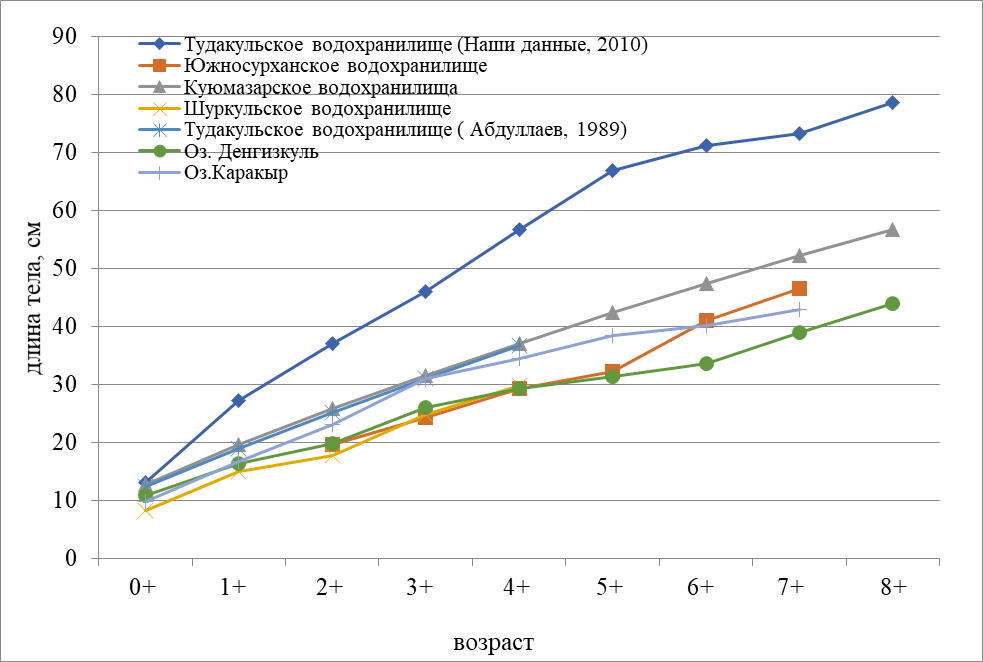
FIG-3. Linear growth of the length of carp (Cyprinus carpio Linnaeus) in some reservoirs of Uzbekistan (according to empirical data).
Another reason for this growth is the stocking of carp by fingerlings whose body length sizes vary significantly both in weight and body length. Such a disparity in the growth of fingerlings is further manifested in the disparity of the same-aged fish in the subsequent years of their life. This phenomenon is also observed in the offspring of carp spawning in the reservoir, which is a consequence of the proportionality of spawning of these fish (Fig. 1, 4).
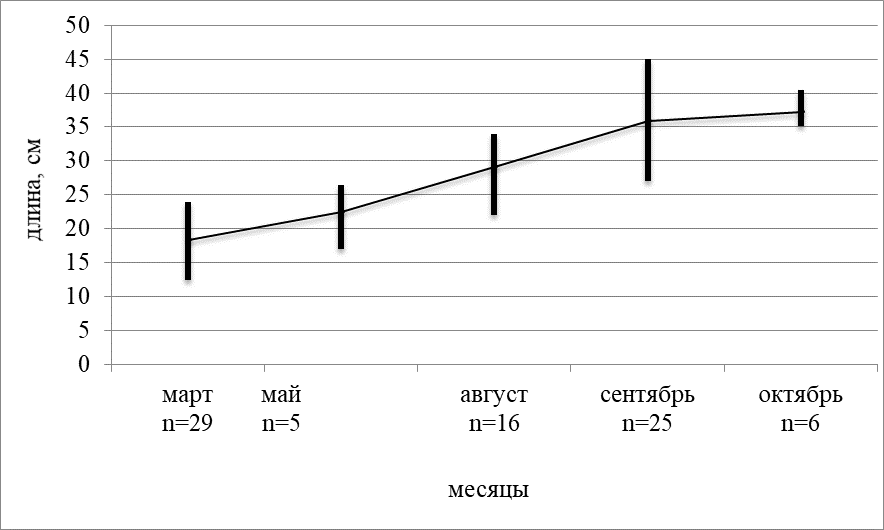
FIG-4. Linear growth of two-year-old carp (Cyprinus carpio Linnaeus) Tudakul reservoir (according to empirical data, 2008).
Spawning and spawning are closely related to hydrometeorological conditions, primarily with thermal and level regimes of the reservoir.
Carp spawning is portioned, and the spawning process is stretched from mid-March to the end of July. The share of the first portion accounts for 80-90% of all caviar in the gonads, and therefore the formation of its reserves is largely associated with the effectiveness of the first-portioned spawning. The removal of each portion of caviar in the population lasts up to a month, depending on the weather. However, mass spawning of one portion lasts no more than 4-6 days.
Spawning usually takes place in the coastal strip of the reservoir in a well-warmed shallow zone, among hard and soft aquatic vegetation at a depth of 20-60 cm. Last year's flooded meadow vegetation serves as a spawning substrate during spring floods. The duration of incubation of carp eggs, depending on the water temperature, lasts from 3 to 7 days.
Conclusions. Intensive growth of the carp of the Tudakul reservoir is observed at the age of two when it first reaches puberty.
The obtained data on the linear growth of the carp of the Tudakul reservoir is significantly higher compared to the literature data of other reservoirs.
The proportionality of carp spawning and stocking with different-quality fingerlings is further manifested in the disparity of the same-aged fish in the subsequent years of their life.
Used literature
- 1. М.А. Абдуллаев, Д.У. Урчинов, Промысловые рыбы водоемов низовьев р.Зарафшан, Фан, Ташкент, 1989. с. 69.
- 2. Г.В. Никольский, Вопросы ихтиологии, № 6-89, т. 14, (1974)
- 3. И.Ф. Правдин, Руководство по изучению рыб, Пищевая промышленность, Москва, 1966, с. 230-266.
- 4. Ю.А Привезенцов, В.А. Власов, Рыбовоство, Мир, Москва, 2007, с. 302.
- 5. З.Д. Саидов, Сб. «Биологические основы рыбного хозяйства водоемов Средней Азии и Казахстана», Фан, Ташкент, 1983, с. 214- 215.
Комментарии