
THE BINDING BETWEEN QUANTUM DROPLETS IS THE COLLISIONS BETWEEN THEM
Abstract
This is devoted to quantum droplet collisions and single droplet motion. In particular, for the latter topic, we aim to develop a diagram of the droplet norm and wavenumber stability of the excitation.
Keywords
Droplets, soliton, deflect, nonlinear wave
The binding between quantum droplets is the collisions between them
S.M.Usanov1,a, SH.M. Usanov 2,b
1Kimyo International University in Tashkent, 156 Usman Nasyr Str., 100121, Tashkent, Uzbekistan
2Tashkent Institute of Irrigation and Agricultural Mechanization Enginees, National Research University
Annatatsiya: This is devoted to quantum droplet collisions and single droplet motion. In particular, for the latter topic, we aim to develop a diagram of the droplet norm and wavenumber stability of the excitation.
Keywords: Droplets, soliton, deflect, nonlinear wave
A soliton is nonuniform coherent wave self-trapped due to the action of the nonlinear dispersion. It is capable to maintain its shape while moving at a constant velocity. In our case, the wave function, ψ(x), given by Eq. (3) is shaped by the interplay of quadratic and cubic terms in Eq. (1) for the droplet, similarly to the shape of the usual bright solitons. The time evolution of the wave function, ψ(x,t) = exp(−iµt)ψ(x,t), preserves the constant density profile, n(x,t) = |ψ(x,t)|2, also in the case when the droplet is moving at a constant velocity. [1-6]
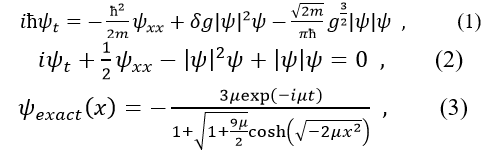
Another distinct feature of a solitons in (nearly) integrable systems is that its shape must not be altered in a collision with another soliton. From this perspective, it is important to verify a possible persistence of the shape of droplets involved in the pairwise collisions. To address this issue, we simulated Eq. (2), using the split-step method based on the fast Fourier transform. The initial wave function was taken as a set of two counterpropagating droplets,
ψ(x,t=0) = eikx/2+ϕψ1(x+x0)+e−ikx/2ψ2(x−x0) (4)
where ψ1(x) and ψ2(x) are the stationary shapes of droplets with normalization N1 and N2, borrowed from Eq. (3), ±x0 are their initial positions, ±k/2 are initial momenta of the colliding droplets, and ϕ is the relative phase. [7-11]
Figure 1 shows density plots of the colliding droplets for a number of characteristic values of the relative momentum k and norms N1, N2. The incident profile is the nearly Gaussian or a “puddle” one, for small and large N, respectively. In the former case, N1 = N2 = 0.1, the shape of each droplet is precisely preserved after the collision. At the collision point, an interference pattern might appear [see Fig. 1(a)], being a distinctive feature of the interplay of coherent matter waves. The interference is well visible for k ≳ 1/W, where W is the width of the droplet. As shown in Section II, the droplet’s properties in this regime, N ≤ 1, are well captured by the Gaussian-based VA.
The situation is quite different for large droplets, see Figs. 1(b,c). In this case, the shape of the droplet is no longer preserved after the collision. The example shown in Fig. 1 (b) corresponds to the collision of fast-moving droplets (k = 1, N1 = N2 = 10), with the large momentum, in comparison to the droplet’s inverse width. The interference pattern is clearly visible at the moment of the collision, resulting in the formation of three outgoing droplets. Both incoming droplets undergo fragmentation, forming an additional quiescent one. The norm of the newly formed stationary droplet is small, with a majority of the particles being kept in the moving ones.
In the case of slowly moving droplets (k = 0.1, N1 = N2 = 20), shown in Fig. 1(c), a majority of the particles stay trapped in the newly formed central droplet, with only relatively small numbers of particles kept by the outgoing droplets. The merged central droplet is highly excited, showing large-amplitude oscillations. In the following subsection we address in more detail conditions under which a strongly excited droplet remains stable or suffers fragmentation. [12-14]
We also analyze collisions of droplets with unequal norms in panels (d,e) of Fig. 1. In Fig. 1(d) we examine a scattering between two small Gaussian-like droplets. In this case no significant excitation is visible, the droplets rather behave as unperturbed objects. Still their scattering is not fully elastic, as the trajectories are affected by the collision. In Fig. 1(e) a large “puddle” droplet N = 10 collides with a small droplet with N = 1. It can be seen that the large droplet becomes highly excited, exhibiting internal periodic vibrations. On the opposite, the small droplet remains essentially in an unperturbed shape, although its trajectory is deflected.
We study the effect of the relative phase on the collision. Figures 1(f,g) show example with out-of-phase scattering. The phase difference of π is known to effectively induce repulsion between solitons [15, 16]. We see that both small (f) and large (g) droplets with equal norms indeed bounce back at the moment of the collision, so that the final trajectory can be interpreted as a total reflection. While for phase π there is no excitation of the equal-norm droplets, this is not the case for some other phase differences. Figure 1(h) shows two large droplets colliding with phase difference of π/2. In this case the outcoming droplets can be excited and are unequally distributed in terms of normalization. The larger droplet is less deflected, similarly to the case (e) of unequal masses. As the phase difference is decreased, the lateral outgoing droplet becomes smaller, see Figs. 1(g,h,c). The breaking of the symmetry between the originally identical droplets in this case can be explained following the line of Ref. [17], as a consequence of the mismatch between the “amplitude” and “phase” centers of the two-droplet configuration with a phase shift different from 0 and π. Eventually for zero difference, see case (c), the merged becomes stationary and two lateral droplets are formed.
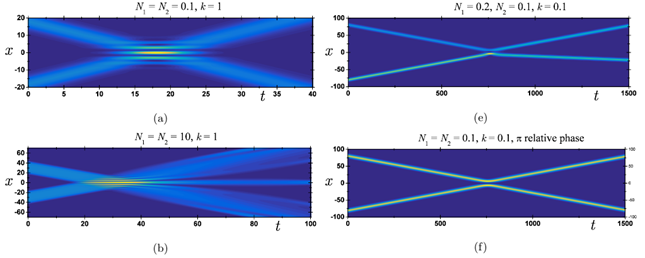
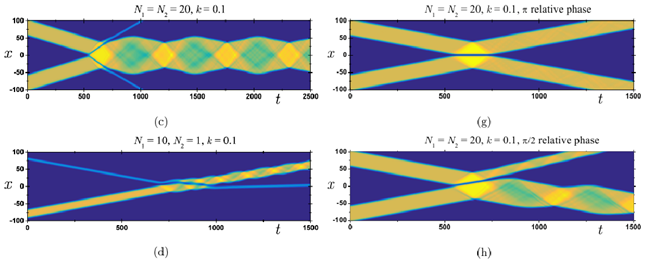
Figure 1: (Color online) The density plot of the time evolution showing an interference pattern generated by collisions of two droplets, labeled by the normalizations (N1 and N2) and the incident momentum k. All cases correspond to the in-phase collisions (ϕ = 0), except when stated otherwise.
References
C. R. Cabrera, L. Tanzi, J. Sanz, B. Naylor, P. Thomas, P. Cheiney, and L. Tarruell, Science 359, 301 (2018).
2. G. Semeghini, G. Ferioli, L. Masi, C. Mazzinghi, Wolswijk, F. Minardi, M. Modugno, G. Modugno,M. Inguscio, and M. Fattori, ArXiv e-prints (2017), arXiv:1710.10890 [cond-mat.quant-gas].
3. P. Cheiney, C. R. Cabrera, J. Sanz, B. Naylor, L. Tanzi, and L. Tarruell, ArXiv e-prints (2017), arXiv:1710.11079 [cond-mat.quant-gas].
4. F. Cinti, A. Cappellaro, L. Salasnich, and T. Macr`ı, Phys. Rev. Lett. 119, 215302 (2017).
5. V. Cikojevi´c, K. Dˇzelalija, P. Stipanovi´c, L. Vranjeˇs Marki´c, and J. Boronat, ArXiv e-prints (2017),arXiv:1708.01553 [cond-mat.quant-gas].
6. R. R. LOVE, The Quarterly Journal of Mechanics and Applied Mathematics 2, 428 (1949).
7. P. C. Hohenberg, Phys. Rev. 158, 383 (1967).
8. G. Kirchhoff, Monatsb. Deutsch. Akad. Wiss. Berlin 144, 48 (1877).
9. M. Gaudin, Phys. Rev.A4, 386 (1971).
10. B. A. Malomed, Progress in Optics(Elsevier, 2002) pp. 71–193.
11. I. Ferrier-Barbut, M. Wenzel, F. Bo¨ttcher, T. Langen, M. Isoard, S. Stringari, and T. Pfau, ArXiv e-prints (2017),arXiv:1712.06927 [cond-mat.quant-gas].
12. L. Pitaevskii and S. Stringari, Bose-Einstein Condensation and Superfluidity (International Series of Monographs on Physics) (Oxford University Press, 2016).
13. S. Stringari, Physics Letters A107, 36 (1985).
14. A. Pricoupenko and D. S. Petrov, ArXiv e-prints (2018), arXiv:1802.02113 [cond-mat.quant-gas].
15. G. I. Stegeman and M. Segev, Science286, 1518 (1999).
16. J. H. V. Nguyen, P. Dyke, D. Luo, B. A. Malomed, and R. G. Hulet, Nature Physics 10, 918 (2014).
17. L. Khaykovich and B. A. Malomed, Phys. Rev. A74, 023607 (2006).
18. L. Parisi, G. E. Astrakharchik, and S. Giorgini, ArXiv e-prints (2018), arXiv:1801.03446 [cond-mat.quant-gas].
19. S.M. Usanov, M.E. Akramov, Sh.M. Usanov, “Tarmoqlangan to'lqin o'tkazgichlarda ikkinchi garmonik avlod”
https://scholar.google.com/citations?view_op=view_citation&hl=ru&user=nXwUCG8AAAAJ&citation_for_view=nXwUCG8AAAAJ:u-x6o8ySG0sC
20. M. Akramov, K. Sabirov, D. Matrasulov, H. Susanto, S. Usanov, and O. Karpova, Phys. Rev. E 105, 054205 (2022).
Comments