
Solution of the time-independent NLSE on simplest graphs
Abstract
In general case this system can be solved using the different (e.g., Newton’s or Krylov’s method) iteration schemes. However, below we will show solvability of this system for two special cases
Keywords
spectrum, elliptic integral, finite interval
SOLUTION OF THE TIME-INDEPENDENT NLSE ON SIMPLEST GRAPHS
S.M. Usanova, M.E. Akramovb, H.T. Yusupova
a Kimyo International University in Tashkent, 156 Usman Nasyr Str., 100121, Tashkent, Uzbekistan
bPhysics Department, National University of Uzbekistan, Vuzgorodok, Tashkent 100174,Uzbekistan
Annatatsiya: In general case this system can be solved using the different (e.g., Newton’s or Krylov’s method) iteration schemes. However, below we will show solvability of this system for two special cases.
Keywords: spectrum, elliptic integral, finite interval
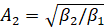
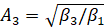
The boundary conditions are given as ( is real;
 ,
 ,
 ):
 (1)
 (2)
 (3)
and the wave function is normalized as fallows:
 (4)
Using Eqs. (2)-(4) and the relations

 (5)
we obtain the system of transcendental equations with respect to  and
 (j=1,2,3), which gives us the spectrum of the eigenvalues stationary NLSE on primary star graph:

 (6)

 (7)


 (8)
Here  and
 are the incomplete elliptic integral of the second kind and the Jacobi amplitude, respectively.
In general case this system can be solved using the different (e.g., Newton’s or Krylov’s method) iteration schemes. However, below we will show solvability of this system for two special cases.
First case:
 (9)
where 
Choosing
 (10)
we hawe  . Here K(k) is the complete elliptic integral of the Eqs. (6) and (7) are valid under these conditions. Using Eq. (8) and the relations
 (11)
 (12)
we hawe
 (13)
Solvability of Eq. (13) is equivalent to that of NLSE on primary star graph. Therefore we will prove solvability of this equation. Indeed, it follows from the relations

and from the fact that g(k) is a continous function of k on the interval (0; 1), that Eq. (13) has a root.
Second case:
Now we consider another special case given by the relations
 ,
where  ,
 and
 cannot be odd or oven at the same time and show existence of the solution of the system given by eqs. (6)-(8). From Eqs. (4) and (6) we obtain

From Eq. (7) we hawe 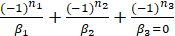 . Furthermore, it follows from the last equation and Eq. (8) that
 (14)
Therefore we hawe  .
Since g(k) is a continuous function of k on the interval (0; 1), it follows from the last relations that Eq. (14) has a root. This can be seen from Fig. 1 that represents the plot of function g(k). In Fig. 1 the solution of Eq. (7) corresponding to this root is plotted.
It should be noted that unlike the first special case, the second case describes primary star graph can be solved with the same success as that for finite interval, treated in Refs.
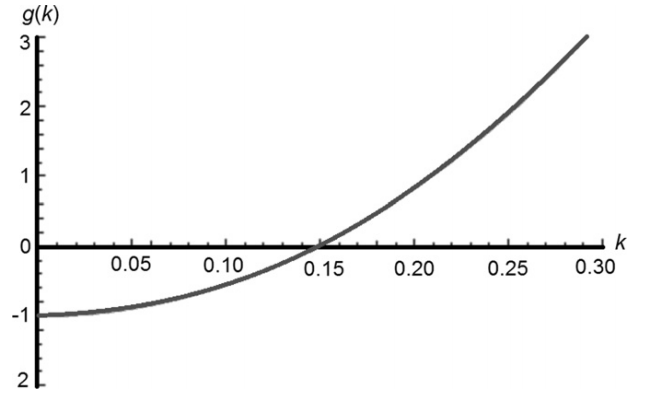
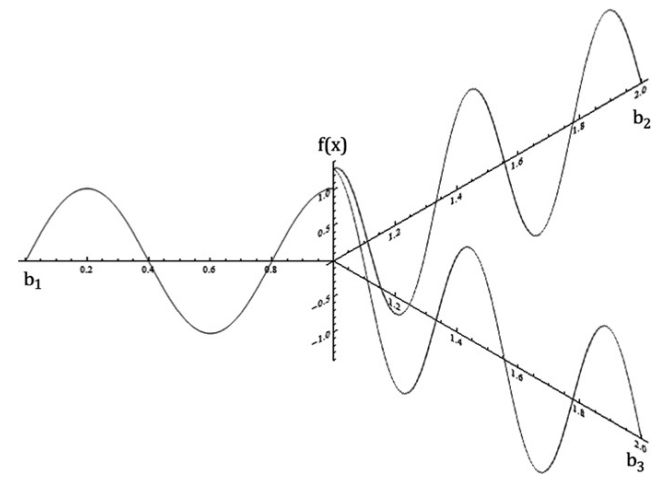
Figure 1: Plot of the function g(k) defined by Eq. (14)
for  .
Solution of Eq. (14) on primary star graph for the root of Eq. (2) found in Fig.
References
- A.Sihvola (2007), Metamaterials in electromagnetics, Metamaterials1, 2-11.
- Aos Al-waidh (2009), metamaterials, General Engineering Research Institute, John Moores University
- B .Monk (2000),Metamaterials-Critique and Alternatives, A John willey sons, INC publications, Merits.
- Christian Imhof · RemigiusZengerle(2008) Experimental verification of negative refraction in a double crossmetamaterial© Springer-Verlag 2008.
- D. Schurig, J. J. Mock, B. J. Justice, S. A. Cummer, J. B. Pendry, A. F. Starr, and D. R. Smith,(2006) “Metamaterial Electromagnetic Cloak at Microwave Frequencies,” Science, vol 314,. no. 5801, pp.977 – 980.
Enghetaand Ziolkowski, R. W., (eds.) (2006), ElectromagneticMetamaterials: Physics and Engineering Exploration, Willey-IEEE PRESS, NewJersy, U.S.A
Comments